The Corporate Artist Buy the book
01 · The definition

The Corporate Artist: The Art of Working Beautifully

Someone paid to create from within a corporate environment.

To make choices, solve problems, shape experiences, build relationships, interpret information, and change what happens next.

Your title does not decide whether you are creative. Your decisions do. A finance leader creates a way of seeing the business. An engineer creates possibility from constraint. A manager creates the conditions other people work inside.

Sometimes we create clarity. Sometimes confusion. Not everything we make is good. We are making it either way.

What is The Corporate Artist about?

You are being paid to create. Not only when you make something beautiful: when you choose the words in an email, when you change the temperature of a meeting. The Corporate Artist: The Art of Working Beautifully is a field manual for seeing that, and for working with what gets in its way: the character you play at work, the voice that sounds like quality control and acts as a kill switch, the contraction that isn’t burnout. Thirty-six chapters, each with a true story from working life and one thing to try.

If you loved The Artist’s Way, The War of Art or The Creative Act, this is the same substrate, pointed at the workplace, with co-creation as the method. See how it sits beside them →

The book at a glance

The premise

You are being paid to create. Your conversations, choices and relationships shape the conditions around the work, whether you call it creativity or not.

Who it is for

People working inside organisations who want to bring more of their creative selves to everyday work, whatever their job title.

What you will find

Stories from working life, practical experiments, reflective questions and inquiry into craft, fear, the characters we play and how we co-create with others.

Book and author

The Corporate Artist: The Art of Working Beautifully by Morgan Sage Norman.

Read Chapter 6

Open the book.

Recognition begins with the work you already do. These opening pages introduce the Corporate Artist.

The Corporate Artist, printed page 14. Readable text follows this page pair.
Page 14
The Corporate Artist, printed page 15. Readable text follows this page pair.
Page 15
Read these pages as text

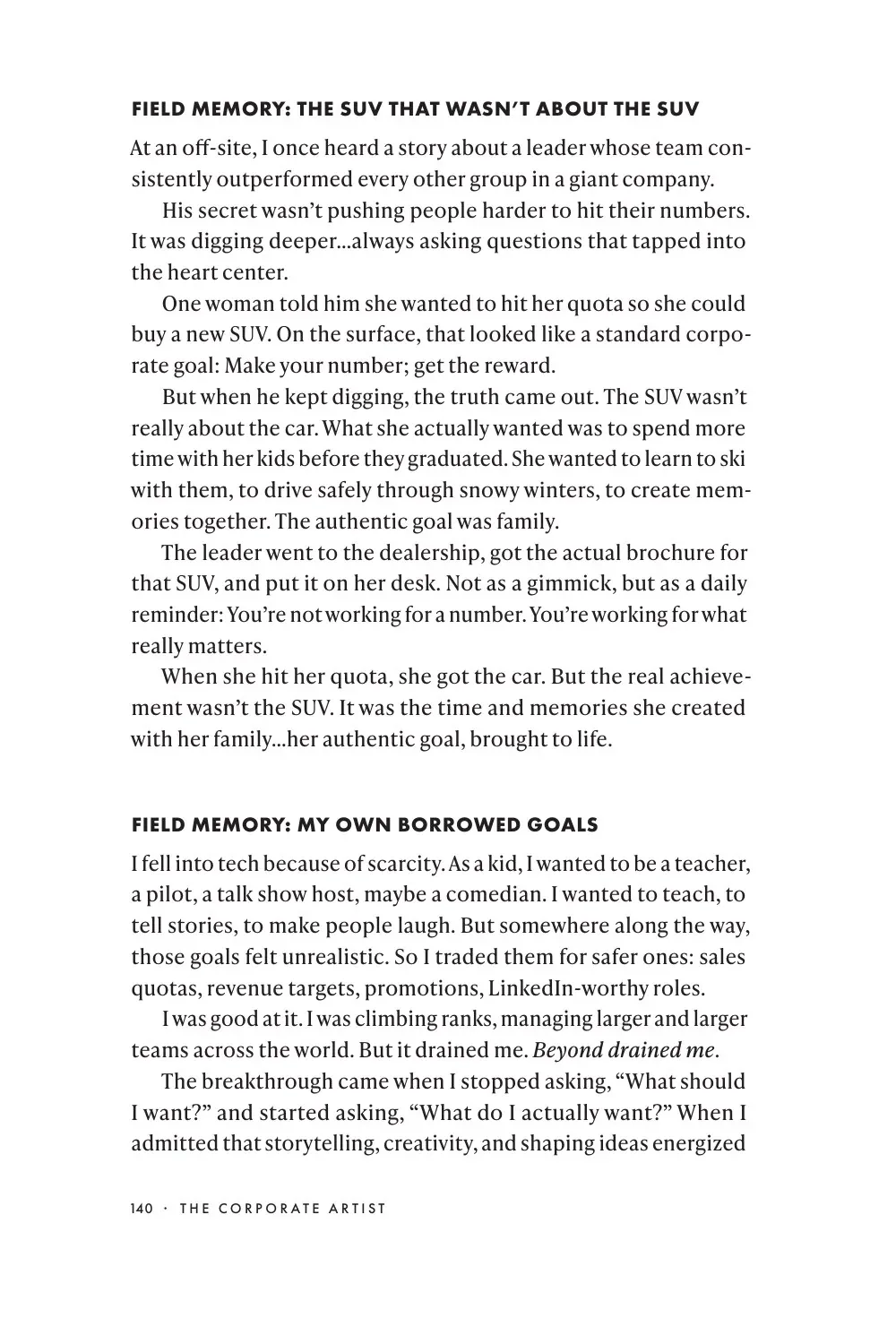
The awakening of the Corporate Artist

You’ve been living a lie. Not intentionally. Not maliciously. But a lie all the same.

The lie is that you are just an employee. That work is an obligation. That creativity is something other people do in other places—people who sit in corners with art on the walls. That the workplace is where you trade your dreams for deadlines and grind but never grow.

This is where that lie begins to crack.

Because here’s the truth: You are a Corporate Artist. You always have been. Work hasn’t killed your creativity. It’s been your canvas all along.

Recognition feels like remembering something you once knew but forgot. Like waking up from a dream you didn’t realize you were having. Like seeing clearly for the first time in years.

Every role is creative. Every job bends reality in some way. You are not separate from creation. You are creation—expressed through quarterly reports, messy presentations, tense meetings, and moments where you almost lost your nerve but didn’t.

I remember sitting in a budget meeting years ago, watching a project get cut because the numbers didn’t add up. Everyone looked defeated. The story in the room was: Creativity ends here. Then one colleague spoke up. He sketched a scrappy work-around on the whiteboard—a way to shift resources without killing the idea. It wasn’t flashy. It wasn’t “creative” in the official sense. But it saved the project.

That’s when it hit me: Work isn’t where creativity dies. It’s where it hides in plain sight.

The costume will slip. The character you’ve been playing will reveal itself as just that—a character. And underneath, you will find the artist you never stopped being.

This is where the awakening begins. Once you see it, you cannot unsee it. There is no going back.

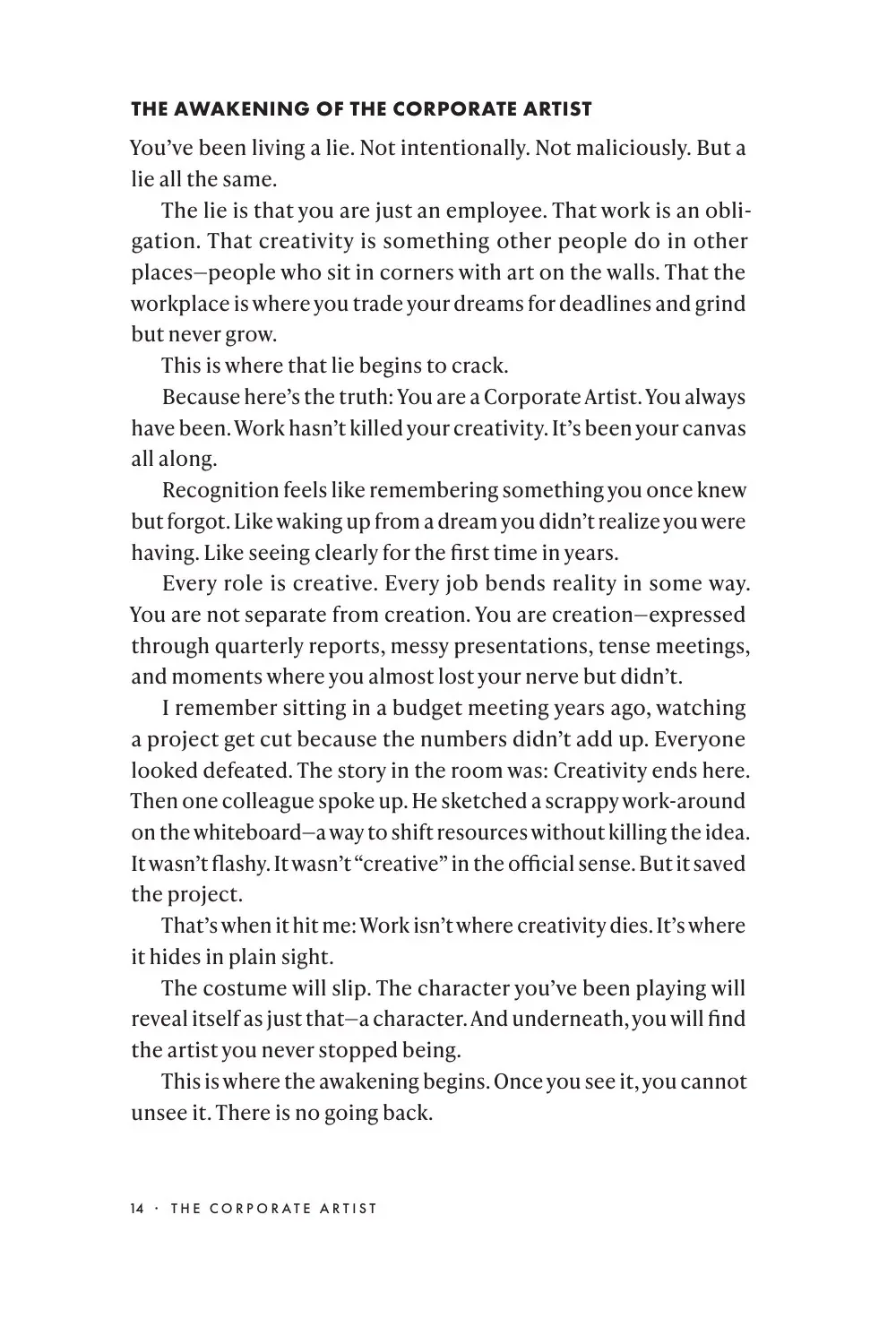
But recognition is only the beginning. Awareness alone isn’t enough. You have to experience it. You have to live it.

Every day. Every decision. Every act of creation in the place you call work.
The professional character is not false. It is incomplete.
02 · The larger claim

We built a machine for creating together, then forgot how creation works.

Look at what corporations make. Aircraft. Medicines. Semiconductors. Software used by billions of people. No individual created any of them.

And yet corporate life became very good at talking about individual performance, predictability and control, which are not the conditions creation appears to need.

The book is not against the corporation. The corporation is one of the great instruments of collective creation. It is unfinished, which is the interesting part.

What makes a goal your own?

In Chapter 22, “The Practice of Authentic Goals,” an idea becomes a story from working life.

The Corporate Artist, printed page 139. Readable text follows this page pair.
Page 139
The Corporate Artist, printed page 140. Readable text follows this page pair.
Page 140
Read these pages as text

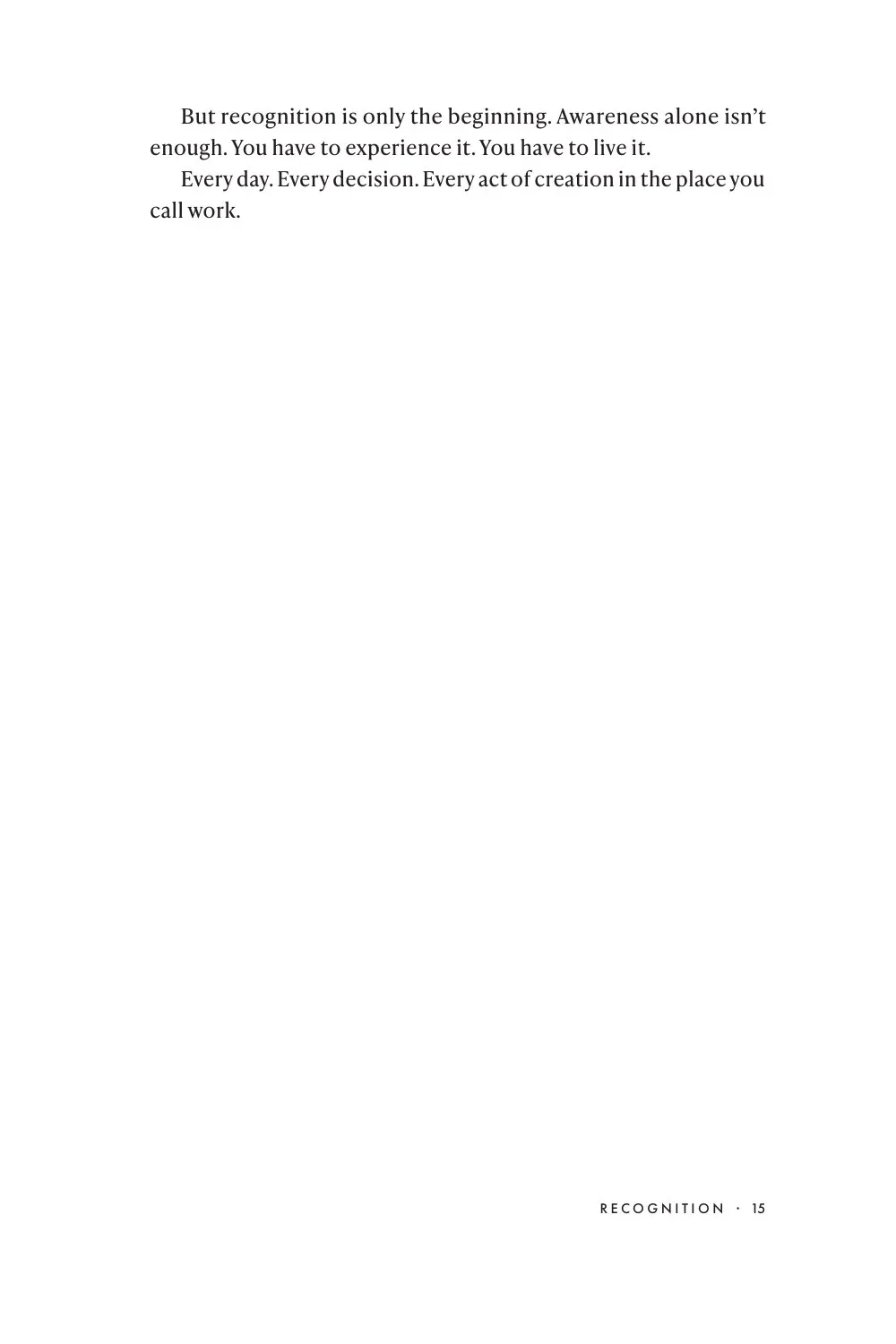
The practice of authentic goals

The lie about success

The lie is that success means hitting the goals handed to you. But if you’ve ever hit the target and still felt empty, you know the truth: It doesn’t work.

The exhaustion isn’t because you can’t reach goals. It’s because you’ve been chasing the wrong ones.

Energy is your fuel. Intention is your compass. Authentic goals are your destination.

Borrowed goals belong to the company, the industry, or someone else’s definition of success. They look impressive but drain you. Authentic goals belong to you. They energize you like one of your favorite songs you can listen to over and over, move through you, and make the work feel alive.

The practice of authentic goals is learning to quiet the world’s shout so you can hear your own whisper.

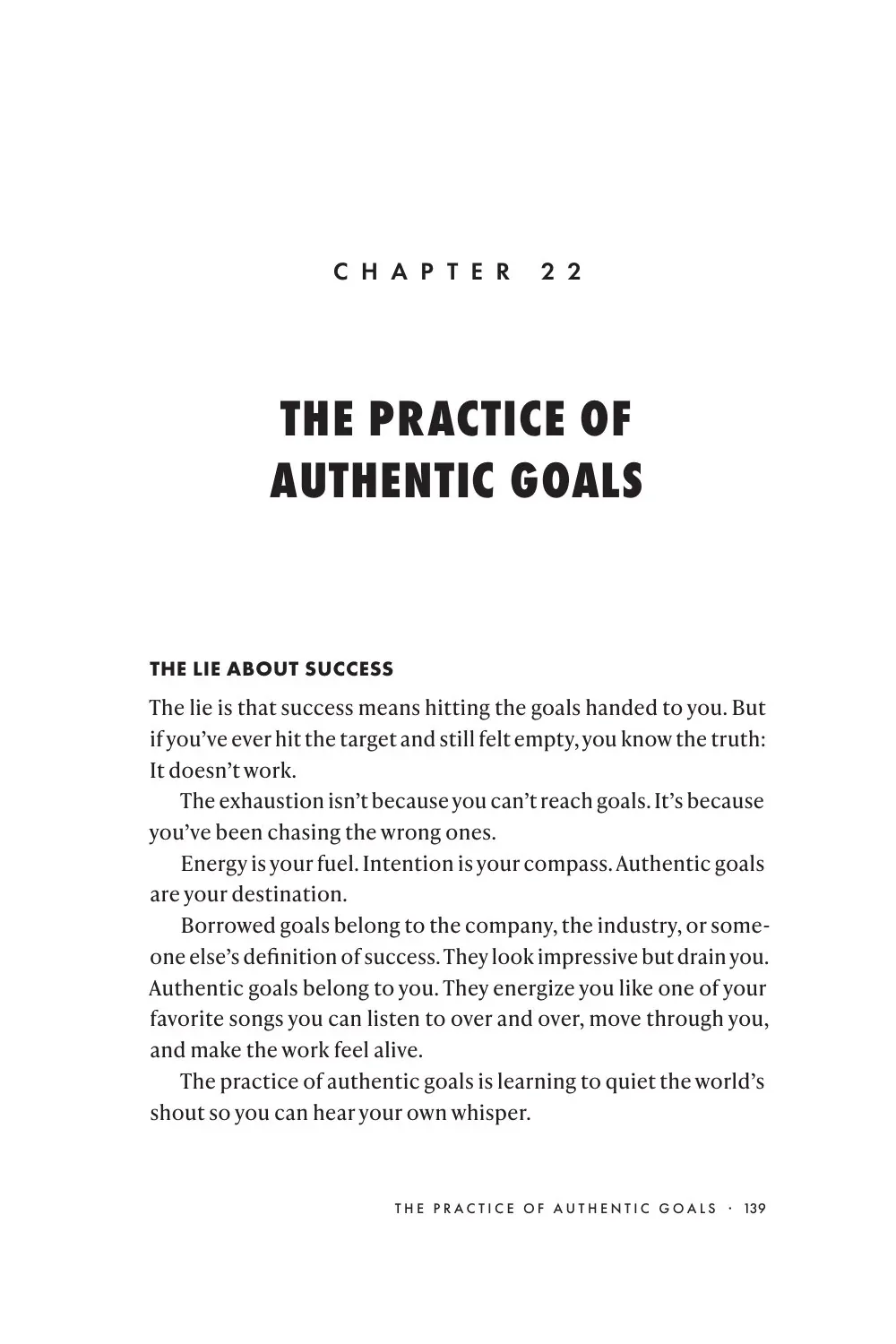
Field memory: The SUV that wasn’t about the SUV

At an off-site, I once heard a story about a leader whose team consistently outperformed every other group in a giant company.

His secret wasn’t pushing people harder to hit their numbers. It was digging deeper…always asking questions that tapped into the heart center.

One woman told him she wanted to hit her quota so she could buy a new SUV. On the surface, that looked like a standard corporate goal: Make your number; get the reward.

But when he kept digging, the truth came out. The SUV wasn’t really about the car. What she actually wanted was to spend more time with her kids before they graduated. She wanted to learn to ski with them, to drive safely through snowy winters, to create memories together. The authentic goal was family.

The leader went to the dealership, got the actual brochure for that SUV, and put it on her desk. Not as a gimmick, but as a daily reminder: You’re not working for a number. You’re working for what really matters.

When she hit her quota, she got the car. But the real achievement wasn’t the SUV. It was the time and memories she created with her family…her authentic goal, brought to life.

Field memory: My own borrowed goals

I fell into tech because of scarcity. As a kid, I wanted to be a teacher, a pilot, a talk show host, maybe a comedian. I wanted to teach, to tell stories, to make people laugh. But somewhere along the way, those goals felt unrealistic. So I traded them for safer ones: sales quotas, revenue targets, promotions, LinkedIn-worthy roles.

I was good at it. I was climbing ranks, managing larger and larger teams across the world. But it drained me. Beyond drained me.

The breakthrough came when I stopped asking, “What should I want?” and started asking, “What do I actually want?” When I admitted that storytelling, creativity, and shaping ideas energized

This selection ends mid-sentence. The story continues on page 141 in the book.

The hard questions.

The idea matters only if it can survive the objections.

I'm not creative.

Try not to create for ten minutes. Do not interpret anything. Do not choose anything. Do not change anyone's experience or decide what matters.

See how long you last.

Isn't calling everyone an artist meaningless?

We are not calling everyone an artist. We are looking at people paid to create inside corporate environments, and asking what becomes visible when their work is understood that way.

What if my job gives me almost no autonomy?

Then the question gets more interesting, not less. Where does choice remain: language, attention, relationship, response?

And where has the system genuinely removed the conditions creation needs? The book does not require pretending every workplace is healthy.

Isn't this just making people content inside bad systems?

That is the risk, and it is real. Any language that helps you find meaning where you already are can be used to keep you there.

What I would say is that seeing your work clearly cuts both ways. People who start noticing what they create at work do not reliably become more compliant. Quite often they become harder to manage, because they stop pretending the thing in front of them is fine.

The book does not require pretending every workplace is healthy. Some of them have removed the conditions creation needs, and naming that is also a use of the frame.

Does this mean everything I create is good?

No. We create fear, confusion, bureaucracy and terrible meetings too. Awareness does not guarantee beautiful work. It gives you a chance to notice what you are taking part in.

Bring your creative self to what comes next.

A newsletter for your working life.

Field notes, reflections and news from The Corporate Artist. A little space to notice what you’re creating, and what you might try next.

Subscribe to The Letter. Unsubscribe at any time. Privacy